


Iconography of Dance in the Middle Ages
International Research Group
Universitat Rovira i Virgili, Tarragona
ICONODANSA
PROJECTE DANAEM

PROJECTE HECO

PROJECTE MUDANSA
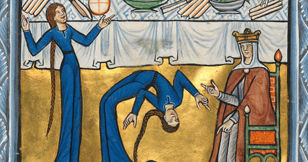
In order to draw up a taxonomy and to define the socio-political functions and the mechanisms of fictitious dance in the Iberian Peninsula, the researchers of the DANAEM project have worked with descriptive or technical texts as well as images of dancing performances previous to the industrial era. A third backbone has been consolidated in recent times: the analysis of the survival of archaic dances, ethnographic documents that, together with textual and iconographic traces, provide us with precious information in order to perceive what it was and what is still is.
The different aspects of the discussion about dance in the medieval and modern period can nowadays be traced back in popular traditions, frequently passed on to us by word of mouth. The same goes for the evolution of dance in indigenous contexts of ethnological and anthropological origin, the cultural roots of the mise en scene of the conflicts and the encounter with the “other” as well as for the definition of religious borders.
The observation of the choreographic and theatrical performances in the Hispanic and Latin-American area allows to identify some key aspects of their evolution to the present day. In the case of Mexico, primitive missionary performances, as Los Doce Pares de Francia and the Morisma de Bracho, where the exaltation of the Christian Faith went hand in hand with the legitimation of the Conquista, were transformed and adapted in the native context due to political, social and cultural changes that underwent with the end of the colony in the XIX century. This fact led to define the ideological and sociocultural implication that pushed the natives to appropriate this type of theatrical dances in order to reflect their own vision of the world and history. This was an active process of reconstruction and recovery of their own past, encouraged by the priests in order to strengthen their faith against the secularisation of the new and free society.
In Spain The archaic Bear Dance, linked to the literary fiction of a wild world, revives the myth of the savage man. The Danse Macabre that moves its steps crossing Europe in order to summon death at the end of the Middle Ages, reappears in Verges, set in the Procession of the Passion, in a strange and dichotomous symbiosis. A dance goes also with King Pàixero, an ephemeral figure typical of the winter celebrations, who rules in a carnival pantomime. The mask, death and fight are also firmly intertwined in the dance of Cetina, where a mummery of baroque origin performed by acrobats, mixes profane and religious elements from old memories. All of them can be observed in five short documentaries produced by ICONODANSA team.
Coordination:
Francesc Massip
Texts:
Beatriz Aracil, Francesc Massip, Raül Sanchis, Eloi Ysàs
Filmmaking:
Eloi Ysàs


